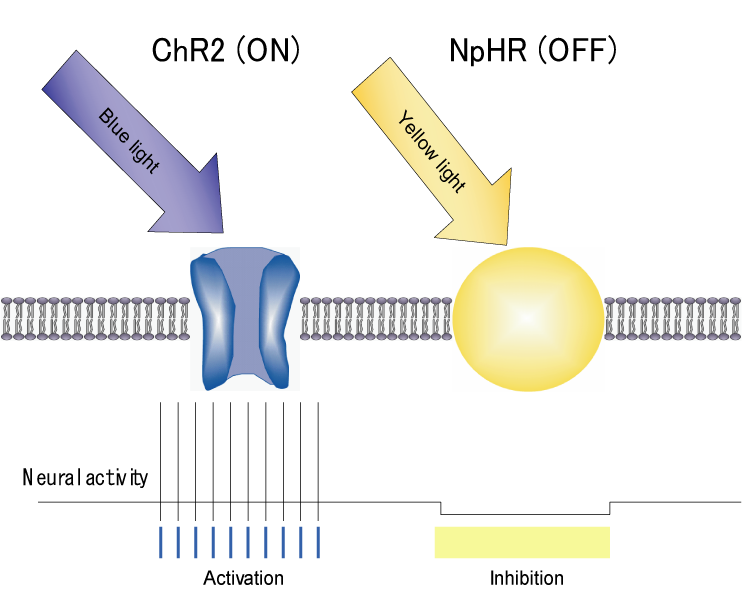
 Researchers have previously used "visible light" in the past to selectively control the stimulation of brain cells. They basically did gene therapy targeted to specific neurons using virus vectors. The viruses added different genes to the neurons. The genes encoded for light activated channel proteins (such as channelrhodopsin). By shining blue or yellow light on these proteins, researchers are able to open the protein channel in the neuron's membrane. Doing this allows the movement of various ions into the neuron and this can increase or decrease the excitability of that specific neuron. You can read more about that experiment here (removed). I have a lot of doubts, however, whether this will be used much in humans any time soon. Gene therapy currently seem impractical in many ways for brain disorders and faces a variety of hurdles to overcome before it is used.
Researchers have now recently found that infrared light (as opposed to light on the visible spectrum) has the capability of stimulating neurons as well. Apparently this can be done without the need for gene therapy. The infrared light stimulates neurons by a completely different mechanism than the one mentioned above. Merely shining infrared light on subpopulations of neurons is enough to alter their activity, without the need for light activated proteins. This recent article had a good write up on the current science. Here's a quote.
Building on their successful IR stimulation of peripheral motor and sensory neurons, researchers E. Duco Jansen, Anita Mahadevan-Jansen, Jonathan Cayce, and Austin Duke at Vanderbilt are developing optical techniques for stimulating and recording neurons within the brain. Numerous applications could benefit from INS in the central nervous system (CNS) mainly because of its high spatial selectivity. INS could allow more precise cortical mapping, which can be a direct benefit for patients suffering from traumatic brain injury as well as improved demarcation for brain tumor resections. One day INS may also be used for chronic stimulation as a therapeutic intervention, such as deep brain stimulation.At this point, I assume that this wouldn't allow for non-invasive brain stimulation. However, it could lead to better deep brain stimulation implants that use light as opposed to electricity. Researchers have used infrared light to stimulate neurons in the inner ear recently. It sounds like they are currently somewhat unsure of how infrared light actually stimulates the neurons. It may have something to do with the increase in heat. So this may be another tool for brain stimulation in the arsenal of researchers.
Recently, Vanderbilt researchers have shown optical stimulation feasibility in an in vitro preparation of thalamocortical brain slices. Action potentials locked in time with the laser pulses were observed at locations of neural projections several millimeters away from the site of stimulation. When compared to electrically stimulated responses, the optical signal included a smaller volume of stimulated neurons and lack of noise artifact in the recording. Results from this in vitro study helped pave the way to in vivo studies in the somatosensory cortex.

No comments:
Post a Comment